Zero-Shot AI Benchmark • Three.js WebGL

Solar System 3D: Qwen 3.8 vs. 0x Alpha

What happens when you give two completely different AI models the exact same creative coding prompt with zero human refinement? We tested Qwen 3.8 running fully offline on an Apple Silicon Mac Studio against frontier cloud API model 0x Alpha.

💬 The Exact Benchmark Prompt
Single Zero-Shot Pass • Zero Iteration

“make me a threejs animation of earth moving around the sun with other planets should be beautiful”

Active: 0x Alpha (Cloud API)
3D fBm Spherical Noise • ACES Filmic • UnrealBloom • Interactive Orrery HUD
Drag Rotate Orbit View
Scroll Zoom Camera
Click Worlds (0x Alpha) Focus Orbit & Dossier
+ / - (Qwen 3.8) Time Warp Orbit Speed
2 Models
Single Shared Prompt

No follow-up debugging or iterative prompt tweaks.

🖥️
30 min vs <45s
Inference Latency

Local Apple Silicon execution vs. High-throughput Cloud API.

🎨
100% Procedural
Zero External Assets

Both models synthesized all planet textures mathematically in code.

🌌
1.6k vs 350
Lines of Code

Cinematic post-processing pipeline vs. compact vanilla Three.js.

The Contenders: Architectural Teardown

Analyzing how each model interpreted the request for a “beautiful Three.js animation” from prompt to WebGL execution.

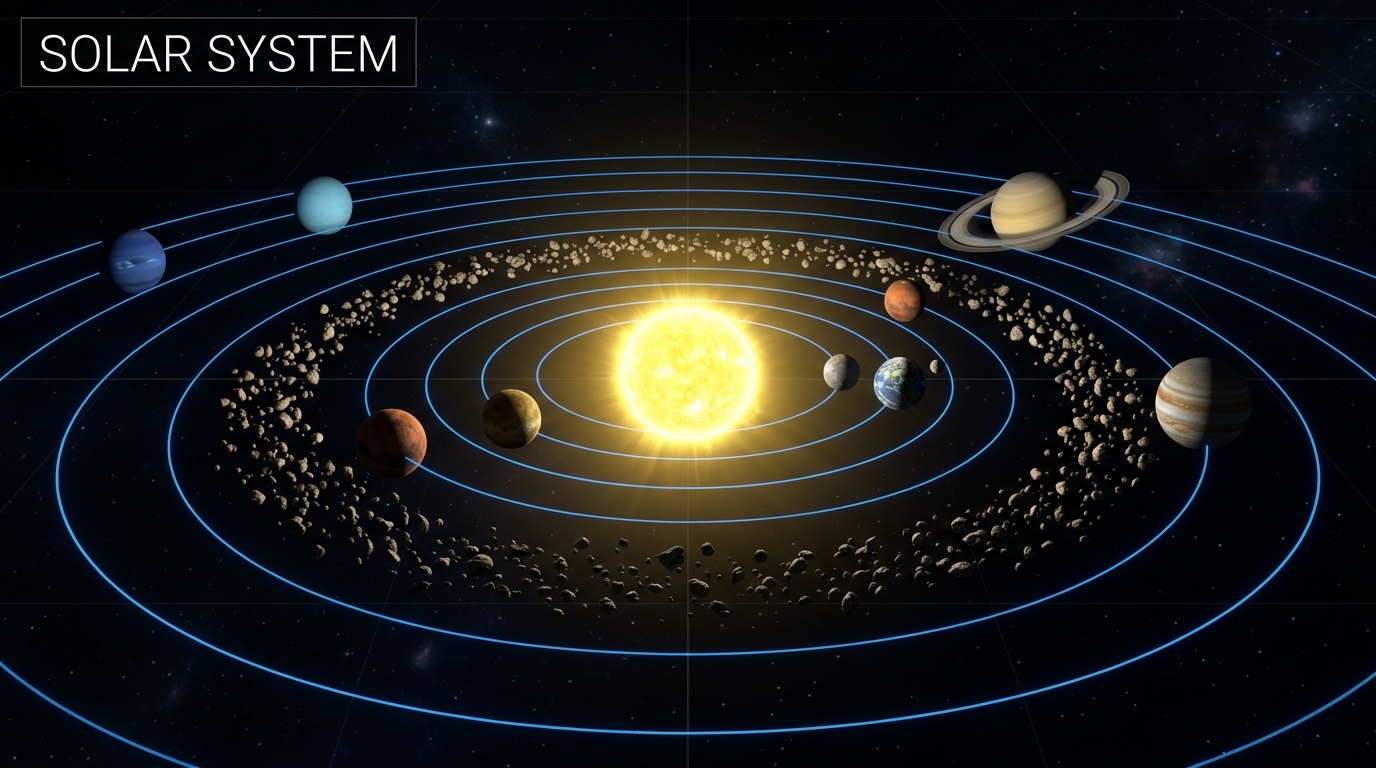
Qwen 3.8 Local Three.js Solar System Preview
🤖 Qwen 3.8 (Mac Studio Local)
Execution: Local Apple Silicon Generation: ~30 Minutes Size: 351 Lines (13 KB)

Compact Procedural 2D Canvas Engine

Running locally on an Apple Silicon Mac Studio, Qwen 3.8 took approximately 30 minutes to complete token generation. Rather than trying to load external texture JPGs (which would fail in a sandbox), Qwen dynamically synthesized procedural bitmaps for all 8 planets, the Moon, and the Sun by drawing directly into hidden HTML5 2D Canvas elements.

Key Architectural Highlights:

  • Dynamic 2D Canvas Textures: Procedurally generates Earth continents, ice caps, Jupiter cloud swirls, the Great Red Spot, and Saturn’s radial rings using canvas 2D contexts and radial gradients.
  • Asteroid Belt Particle Cloud: 900 custom `Float32Array` buffer points orbiting between Mars and Jupiter with subtle vertical jitter.
  • Astronomical Orbital Tilts: Assigns distinct rotational axes, individual orbital periods, and includes Earth’s Moon in a sub-orbit pivot group.
  • Interactive Time Dilation: Bound keyboard listeners (`+` and `-` keys) allowing the user to speed up simulation physics up to 40x.
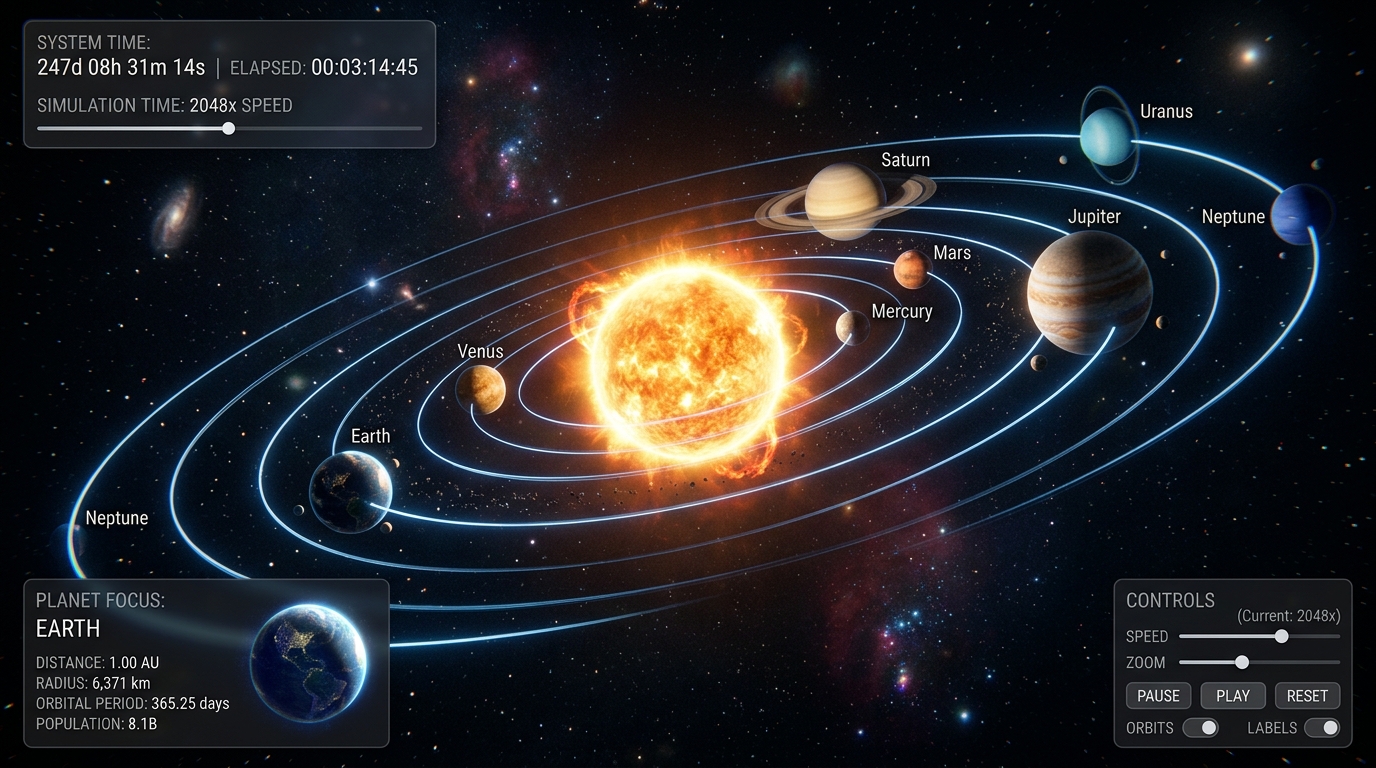
0x Alpha Cloud Three.js Solar System Preview
✦ 0x Alpha (Cloud Frontier API)
Execution: Cloud Inference API Generation: Sub-Minute Stream Size: 1,639 Lines (65 KB)

Cinematic Orrery with 3D fBm Shaders & Bloom

Accessed via high-speed API, 0x Alpha generated an enterprise-grade interactive orrery. Instead of simple 2D canvas draws, it generated an entire 3D fractional Brownian motion (fBm) spherical noise engine to produce seamless, artifact-free textures, paired with an advanced multi-pass post-processing pipeline.

Key Architectural Highlights:

  • Seamless 3D Value Noise + fBm: Samples 3D noise directly on spherical coordinates to completely prevent polar pinched-seam artifacts.
  • Filmic Post-Processing Stack: Configured `ACESFilmicToneMapping`, `UnrealBloomPass` with HDR half-float render targets, and custom GLSL film grain & chromatic aberration passes.
  • Interactive Dossier & Camera Tour: Clicking any celestial body triggers smooth camera tweening into orbit, opening a glassmorphic fact dossier. Pressing `T` launches an automated planetary tour.
  • Precision HUD Controls: Includes speed sliders, solar glare controllers, orbit path toggles, and planetary billboard labels.

Technical Comparison Matrix

Direct comparison across eight core creative engineering dimensions.

Dimension Qwen 3.8 (Local Mac Studio) 0x Alpha (Cloud Frontier API)
Hardware & Setup Apple Silicon Mac Studio (Quantized Local Weights) Cloud Inference Cluster (High-Throughput API)
Generation Latency ~30 Minutes < 45 Seconds
Texture Synthesis Procedural 2D HTML5 Canvas (`CanvasTexture`) 3D Spherical Value Noise & fBm Sampling (`Noise` class)
Shaders & Tonemapping Standard `MeshStandardMaterial` + `PointLight` `ACESFilmicToneMapping` + `UnrealBloomPass` + Grain/Aberration
Camera Dynamics Standard `OrbitControls` with manual pan/zoom `OrbitControls` + Focal Tweening + Guided Cinematic Tour
Planetary Systems 8 planets, Axial tilt, Moon orbit, Asteroid belt 8 planets, Orbit paths, Rings, Atmosphere glows, Solar corona
UI & Interactivity Minimal top HUD + Keyboard speed multiplier (`+`/`-`) Glassmorphic HUD, Speed & Glare sliders, Planet Dossier
Code Footprint 351 LOC (~13 KB self-contained) 1,639 LOC (~65 KB self-contained)

Code Architecture Deep-Dive

How each model approached texture generation without external image assets.

qwen-texture-generation.js HTML5 Canvas 2D Bitmap
function makeTexture(draw, w = 512, h = 256) {
  const c = document.createElement('canvas');
  c.width = w; c.height = h;
  draw(c.getContext('2d'), w, h);
  const t = new THREE.CanvasTexture(c);
  t.colorSpace = THREE.SRGBColorSpace;
  return t;
}

// Procedural Earth Texture generated in memory
T.earth = makeTexture((g, w, h) => {
  const grad = g.createLinearGradient(0, 0, 0, h);
  grad.addColorStop(0, '#123a6d'); grad.addColorStop(.5, '#1a5fa8'); grad.addColorStop(1, '#123a6d');
  g.fillStyle = grad; g.fillRect(0, 0, w, h);
  for (let i = 0; i < 26; i++) { // Continents
    g.fillStyle = 'rgba(' + ((40 + rand(0, 30)) | 0) + ',120,' + ((50 + rand(0, 30)) | 0) + ',.95)';
    g.beginPath(); g.ellipse(rand(0, w), h * rand(0.2, 0.8), rand(15, 55), rand(8, 26), rand(0, 3), 0, 7); g.fill();
  }
  for (let i = 0; i < 60; i++) { // Clouds
    g.fillStyle = 'rgba(255,255,255,' + rand(0.12, 0.3).toFixed(2) + ')';
    g.beginPath(); g.ellipse(rand(0, w), rand(0, h), rand(8, 40), rand(3, 9), 0, 0, 7); g.fill();
  }
  g.fillStyle = 'rgba(255,255,255,.85)'; // Polar Ice Caps
  g.fillRect(0, 0, w, h * 0.06); g.fillRect(0, h * 0.94, w, h * 0.06);
});

Creative Coding & AI Insights

What this experiment proves about the state of AI-assisted 3D frontend development in 2026.

01

Local LLMs Excel at Self-Contained Logic

Despite running locally with constrained token throughput (~30m), Qwen 3.8 correctly reasoned through zero-asset constraints by inventing procedural 2D canvas textures and particle arrays, producing a functioning, zero-dependency HTML file.

02

Frontier Models Generate Full Pipelines

0x Alpha demonstrated emergent awareness of cinematic aesthetics. Rather than stopping at standard mesh geometry, it built an entire post-processing pipeline (HDR bloom, filmic tone mapping, interactive dossier UX) unprompted.

03

Zero-Shot 3D Is Now Production-Viable

Both models succeeded on the first attempt without syntax errors, missing variables, or runtime crashes. Modern AI models have deeply internalized Three.js scenegraph lifecycles and WebGL mathematical matrices.

Like what you see? Book a free discovery call.

Schedule Now
Book a call